
Artist Statement - 2026
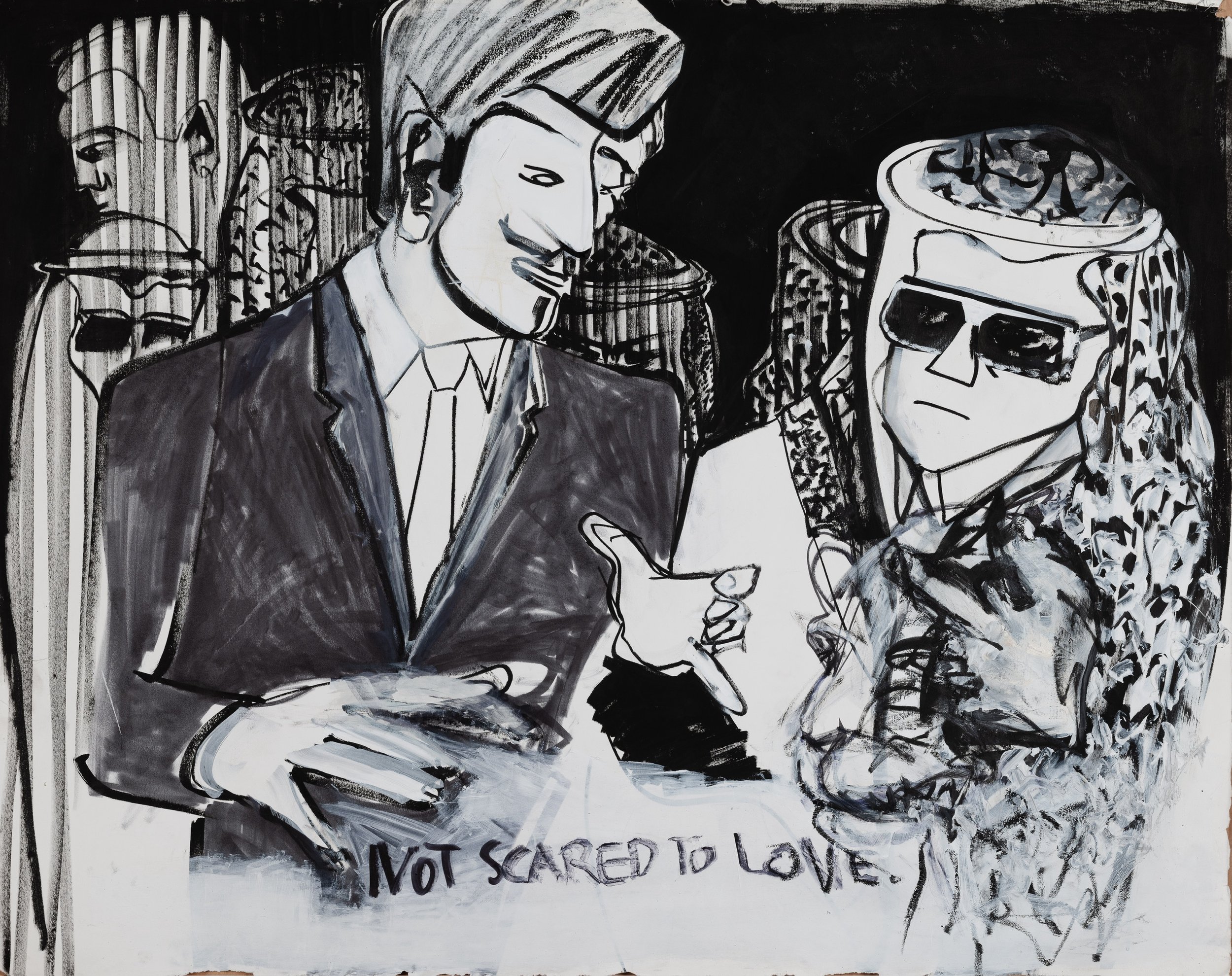
The paintings start with images that are already out there, already circulating — news footage, body camera video, film stills, broadcast television. Somebody on the ground. A hand on someone's arm. Two people too close together to be comfortable. I pull these frames out of the feed, scale them up, and work through them slowly by hand. That's the basic transaction.
The process is accumulation and interference. Figures get laid in, overworked, half-erased, redrawn. Each pass is a revision of the last, and the surface ends up holding all of them simultaneously — a palimpsest of competing attempts rather than a finished image. What you're looking at is the history of looking.
This connects to how visual perception actually works. The visual cortex isn't a camera — it's a prediction engine. The brain is continuously running a generative model of the world, sending top-down predictive signals down through the ventral stream toward primary visual cortex, which checks them against incoming sensory data and returns prediction errors — mismatches that drive the next update. You don't see the world; you see your best current guess about it, perpetually revised. Karl Friston calls this the free energy principle. I think of it as the condition my paintings are designed to exploit. They give you enough signal to start recognizing — a face, a body, a gesture of force — and then they don't close. The fusiform face area fires at a smear of paint. Mirror neurons respond to a drawn arm that might be reaching or might be striking. Whether you resolve the image or not depends on how long you look, how far back you stand, and what you were already expecting to find. The ambiguity is structural, not decorative.
There's a related thing happening with the LLMs series, which came out of spending time with large language models. LLMs don't retrieve stored information — they predict forward through high-dimensional probability space, generating coherence from statistical pressure. Meaning emerges from pattern completion, token by token, with no homunculus behind the curtain deciding what comes next. The paintings in this series are built along the same logic: dense, recursive mark-making where a face or figure condenses out of near-stochastic noise, the way a word solidifies out of a probability distribution. There's no clean line between the signal and the process that generated it. People find the figure before they can say why. That gap — between recognition and explanation — is what the work lives in.
The series titles — murder, body cam, grab em, death and the maiden, protest, together, tvs, wide world — are blunt on purpose. They name the social content that formal density might otherwise swallow. These images come from real situations: coercion, violence, desire, proximity. The neurological machinery that makes the paintings perceptually alive — the predictive processing, the automatic face detection, the motor resonance of implied gesture — is not separate from why those situations are charged in the first place. The brain that finds the figure in the noise is the same brain that made the situation worth filming.
Works develop in series, with controlled variation in scale, density, mark, and color allowing each iteration to recalibrate the viewer's expectations before the next. The series is a methodology — not repetition but iterative error-correction, which is also just another name for how you learn anything.
I work in the woods of rural Anderson Valley. These images come from elsewhere — from the uninterrupted broadcast of human difficulty — and the studio is where they get slowed down long enough to look at.