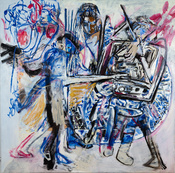
- TVs
(( 80 × 82” - oil on polyester ))
The first thing it does to me is change my size. Everything in that room is bigger than I am — the chair is an upholstered planet, the hand grips something up where I can't reach, the adults are Gods. That's a child's altitude. This painting is seen from about four feet off the ground, and once I feel that, everything else follows: the faces at wrong scales because memory doesn't keep scale, the coat you could hide inside, the furniture with more personality than the people. It isn't a picture of a room. It's a picture of being small in one.
The blues are what make it a home and what make it grieve. Not sky blues — china blues. Willow-pattern, doily, upholstery, workshirt. Blue is the color of things families keep: dishes, denim, tattoos, veins. And the pink is flesh and calamine, the color of scraped knees and of things healing badly. The ochre is old varnish, five o'clock kitchen light. This is the palette of an interior remembered through decades, gone cold in some places and still warm in others.
The tape deck is the heart of it, and it isn't furniture — it's the painting confessing its own method. A cassette is the only household object whose whole nature is recording over itself. Whatever song was playing in that room got taped over, and taped over again, and the machine keeps only the last version — which is exactly what this canvas did to its horse, its riders, its blue crowd. The tape deck sits there like the surface's little self-portrait: I erase to remember. And photographing every version, that is the shoebox of old tapes the machine doesn't know about.
The beam across the middle is the thing nobody in the room mentions. Table edge, plank, barrel — it doesn't matter what it is; what matters is that it crosses the whole space at chest height and everyone arranges themselves around it. Every family room has one. The walker at the left edge is leaving past it, head down, the way someone leaves without saying they're leaving. The scribbled head in the corner — that blue tangle with hearts balloons caught in it — is what he's carrying out the door: a mind full of static with love snagged inside it, undeliverable.
And the woman's divided face is the one holding it all, half one color, half the other — two languages, two loyalties, day-self and night-self — presiding over a room where a horse used to be. That's the deepest ache in it: under the chair, under all that patient domestic blue, there's a buried animal that could have carried everyone out of there. Childhood keeps a horse; adulthood turns it into a chair.
It feels like the last afternoon a family was one thing. Music playing, someone leaving, a child seeing it at the wrong size and keeping it forever. Whatever's true in that belongs to you; whatever isn't, tell me and I'll look again.